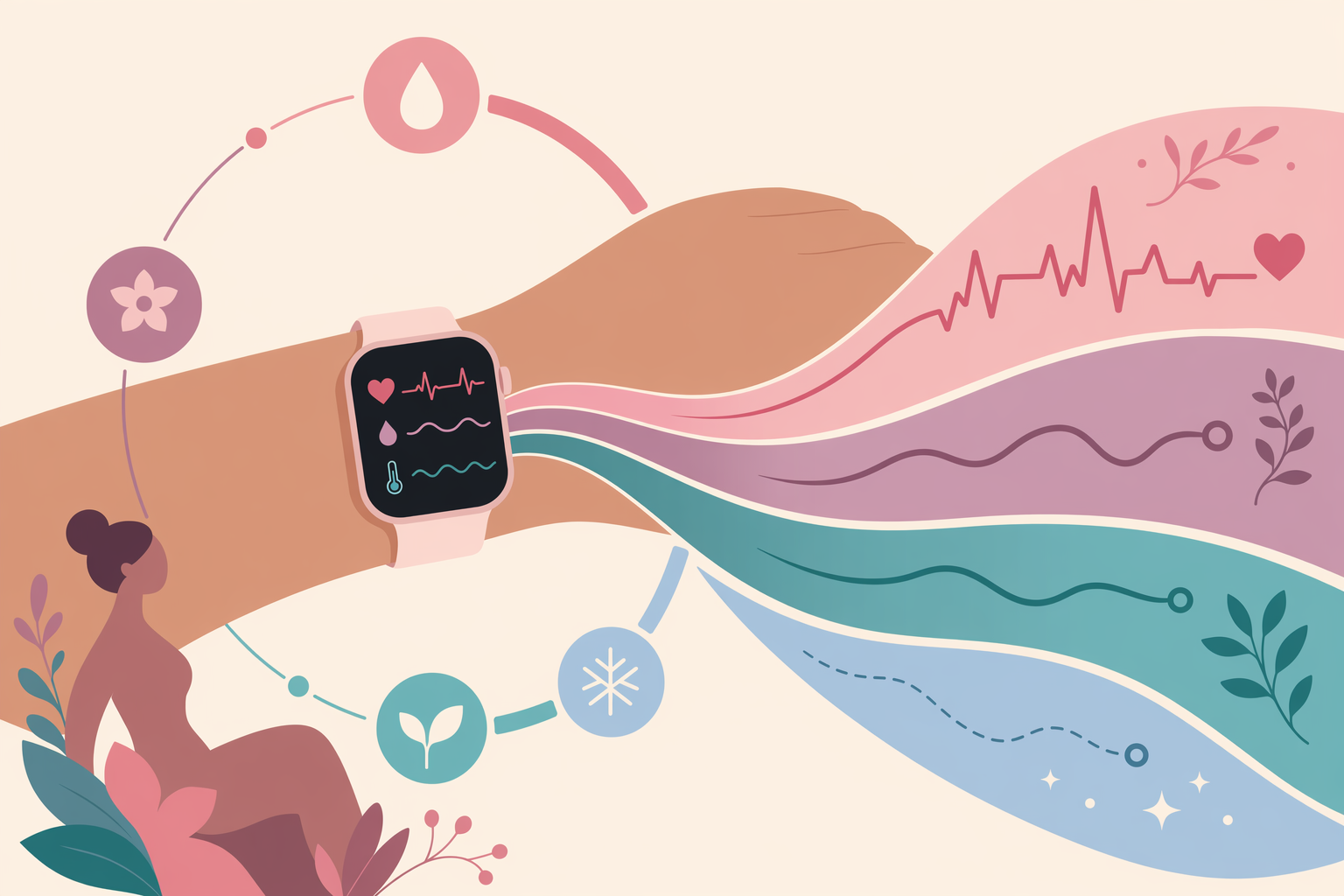
If you wear an Apple Watch to sleep, it collects wrist temperature, heart rate variability, resting heart rate, respiratory rate, and sleep stage data each night. Much of that data may sit in Apple Health without much attention.
For people who menstruate, these metrics can contain a clear, repeating signal that follows the menstrual cycle.
Wrist temperature: the cycle's most visible marker
Apple Watch Series 8 and later measure wrist temperature during sleep. The reading is reported as a deviation from your personal baseline, such as +0.2°C or -0.1°C.
Across the cycle, the usual pattern is:
- During the follicular phase, wrist temperature sits at or slightly below your baseline.
- Within 1–2 days of ovulation, it shifts upward by 0.1–0.3°C.
- It remains elevated for 10–16 days during the luteal phase.
- Just before your period starts, it falls back to baseline.
Progesterone drives this thermal shift by raising the body's thermoregulatory set point after ovulation. Traditional basal body temperature (BBT) tracking measures the same phenomenon. Apple Watch measures it passively.
A 2018 study found that wrist-worn sensors can detect this cycle-related temperature pattern with accuracy comparable to clinical methods.
Heart rate variability (HRV): your recovery metric
HRV, the variation in timing between heartbeats, reflects your autonomic nervous system balance. Apple Watch measures it overnight and reports it in milliseconds (ms).
It tends to change across the cycle as follows:
- HRV is generally higher during the follicular phase, when your parasympathetic (rest-and-recovery) system is more active.
- It drops during the luteal phase as progesterone increases sympathetic nervous system activity.
- It often reaches its lowest point in the late luteal or premenstrual phase.
- Recovery begins in the early follicular phase, around the start of your period.
A 10–25% swing between your highest and lowest HRV readings across the cycle is normal and expected.
Resting heart rate: subtle but consistent
Your resting heart rate (RHR) follows the inverse pattern:
- RHR is lower during the follicular phase, which is associated with a more recovered state.
- It rises by approximately 2–5 bpm during the luteal phase.
- It peaks before your period, then starts dropping at period onset.
The mechanism is the same: progesterone shifts autonomic balance toward sympathetic activation, which raises baseline heart rate.
Sleep stages: quality shifts with hormones
Apple Watch tracks REM, Core (light), and Deep sleep. Research shows that sleep architecture changes across the cycle:
- The follicular phase is associated with more time in deep sleep and better sleep efficiency.
- During the luteal phase, REM sleep is reduced, nighttime awakenings are more common, and sleep-onset latency is higher.
- Premenstrual sleep is often the worst of the cycle because temperature elevation, hormonal withdrawal, and PMS symptoms can occur together.
Respiratory rate: a quieter signal
Respiratory rate during sleep can also shift slightly during the luteal phase, trending 0.5–1 breath per minute higher than the follicular baseline. This metric is noisier than temperature or HRV, though the pattern may become visible across multiple cycles.
Comparing the metrics
No single metric tells the whole story, so it helps to compare them:
| Metric | Follicular phase | Luteal phase |
|---|---|---|
| Wrist temperature | Baseline or below | Elevated (+0.1 to +0.3°C) |
| HRV | Higher | Lower |
| Resting heart rate | Lower | Higher (+2–5 bpm) |
| Deep sleep | More | Less |
| Sleep efficiency | Better | Worse |
When several metrics shift in the same direction, they can provide a stronger indication of your current phase, sometimes before symptoms appear.
What Apple Health doesn't do
Apple Health collects and displays this data, but it doesn't interpret the readings by cycle phase. Temperature and HRV appear on separate timelines. The app does not explain that an HRV drop may coincide with the luteal phase or identify an elevated temperature as the ovulatory shift.
Reviewing those readings together makes it possible to relate them to the underlying hormonal pattern.
Reading the pattern over time
An Apple Watch can track several physiological signatures of the menstrual cycle each night. Looking at the readings together, rather than as isolated graphs, can make the recurring pattern easier to recognize.
References
- Shilaih M, et al. Modern fertility awareness methods: wrist wearables capture the changes in temperature associated with the menstrual cycle. Bioscience Reports. 2018;38(6):BSR20171279.
- Cagnacci A, et al. Modification of circadian body temperature rhythm during the luteal menstrual phase. Journal of Applied Physiology. 1996;80(5):1543-1547.
- Brar TK, et al. Effect of different phases of menstrual cycle on heart rate variability. Journal of Clinical and Diagnostic Research. 2015;9(10):CC01-CC04.
- Moran VH, et al. The relationship between heart rate variability and the menstrual cycle. Clinical Autonomic Research. 2000;10(1):37-42.
- Baker FC, Driver HS. Circadian rhythms, sleep, and the menstrual cycle. Sleep Medicine. 2007;8(6):613-622.
- Somboon T, et al. Respiratory changes across the menstrual cycle. Chest. 2020;158(4 Suppl):A2317.