
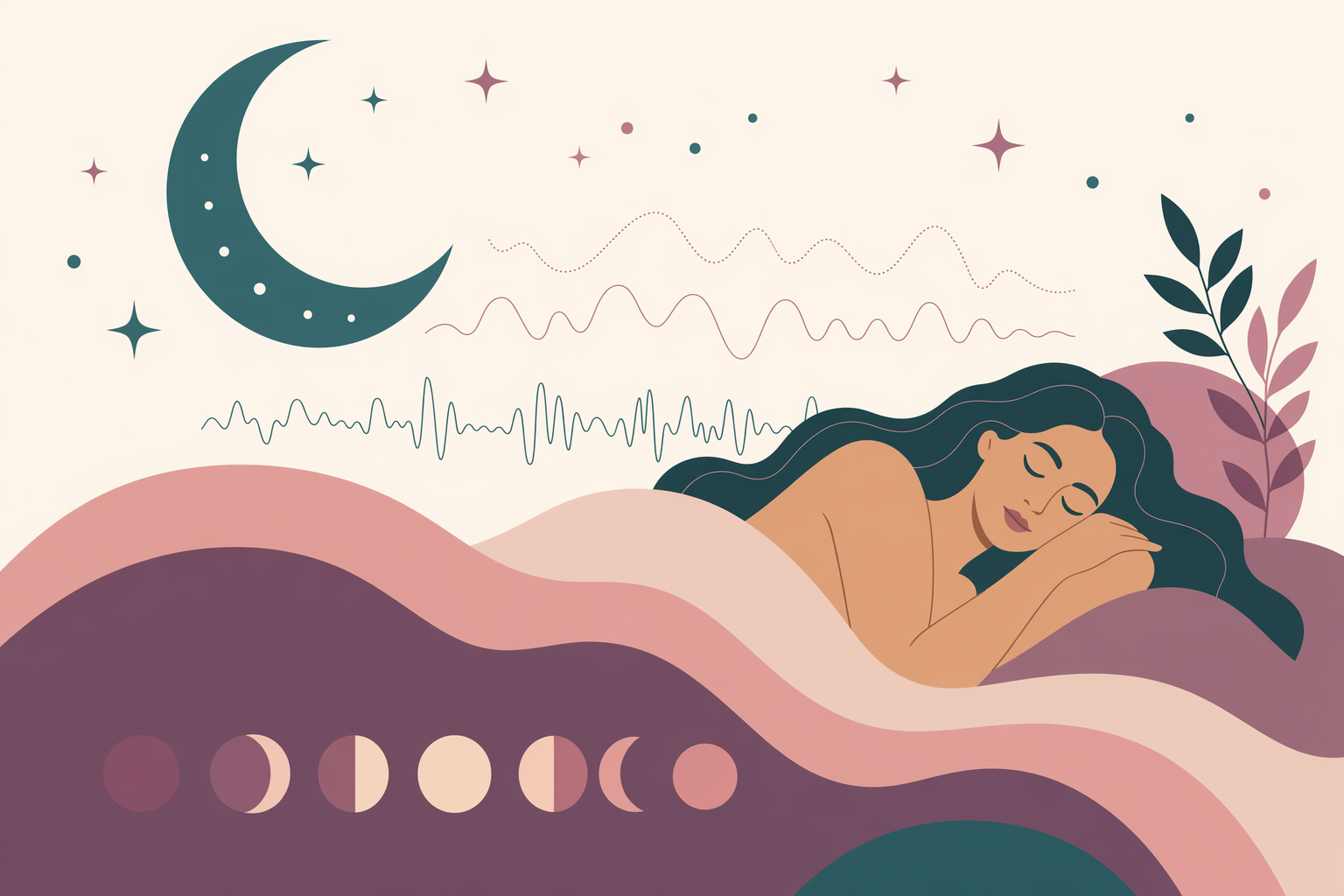
Sleep can feel noticeably different from one week to the next. For people who menstruate, changes in sleep architecture across cycle phases may be part of the reason.
The follicular phase: sleep often improves
Sleep quality tends to be best during the first half of the cycle, from the start of the period through ovulation. Estrogen rises steadily during this phase and supports longer stretches of slow-wave sleep, the deep and restorative stage.
Many people also report:
- Falling asleep faster
- Fewer nighttime awakenings
- Feeling more rested in the morning
If you track sleep with an Apple Watch, this is often when the longest deep sleep durations and highest HRV readings appear.
The luteal phase: sleep may become harder
After ovulation, progesterone becomes dominant. It has a mild sedative effect because it boosts GABA activity in the brain, yet objective sleep quality tends to worsen during this phase.
Studies using polysomnography, the gold standard for sleep measurement, found several changes during the luteal phase:
- REM sleep is reduced, meaning less of the dream-stage sleep that consolidates memory.
- Sleep onset latency increases, so it takes longer to fall asleep.
- Wakefulness after sleep onset (WASO) increases, with more waking during the night.
The role of body temperature
Thermoregulation is a major factor. Progesterone raises basal body temperature by about 0.3–0.5°C. Because the body needs to cool down to initiate and maintain sleep, the higher temperature works against that process.
An Apple Watch may therefore show elevated wrist temperature readings in the second half of the cycle.
The 2–3 days before your period
The sharp drop in estrogen and progesterone just before menstruation creates a hormonal withdrawal. Sleep is often at its poorest point in the cycle, adding to the fatigue many people feel in the days before their period.
PMS symptoms also peak during this window and can further disrupt sleep:
- Cramps and bloating can make it harder to get comfortable.
- Mood changes such as anxiety and irritability can trigger racing thoughts at bedtime.
- Headaches from estrogen withdrawal can disrupt sleep onset.
What your Apple Watch data reveals
Consistent Apple Watch data may show the same pattern. Look for:
- Wrist temperature rising 1–3 days after ovulation and staying elevated until your period
- HRV dropping during the late luteal phase, reflecting increased physiological stress
- Resting heart rate trending 2–5 bpm higher in the luteal phase
Together, these biometric changes can reflect the hormonal environment of the luteal phase.
Practical strategies
- Cool your bedroom by 1–2 degrees during the luteal phase to offset the temperature rise.
- Avoid caffeine after noon in the week before your period, when sleep quality is already compromised.
- Exercise earlier in the day because late-evening workouts can raise body temperature further.
- Track the trend so you can plan for the nights when sleep is usually harder.
Planning around changes in sleep
Hormonal changes can contribute to sleep disruption across the cycle. Tracking your own pattern may help you adjust your schedule around the nights when sleep tends to be more difficult.
References
- Baker FC, Driver HS. Circadian rhythms, sleep, and the menstrual cycle. Sleep Medicine. 2007;8(6):613-622.
- Andréen L, et al. Progesterone effects during sequential hormone replacement therapy. European Journal of Endocrinology. 2006;154(1):141-149.
- Shechter A, Boivin DB. Sleep, hormones, and circadian rhythms throughout the menstrual cycle in healthy women and women with premenstrual dysphoric disorder. International Journal of Endocrinology. 2010;2010:259345.
- Cagnacci A, et al. Modification of circadian body temperature rhythm during the luteal menstrual phase. Journal of Applied Physiology. 1996;80(5):1543-1547.
- Moran VH, et al. The relationship between heart rate variability and the menstrual cycle. Clinical Autonomic Research. 2000;10(1):37-42.