In 2022, period tracker privacy became a more urgent concern. After the U.S. Supreme Court's Dobbs v. Jackson decision, millions of people began asking a direct question: who can access my cycle data?
With many popular period apps, the answer includes more parties than users may expect.
The problem with cloud-based period trackers
Most period tracking apps use a standard SaaS model. You create an account, your data syncs to the company's servers, and the company controls how it is handled. That arrangement creates several risks.
Data subpoenas and law enforcement access
When your cycle data is stored on a company's servers, law enforcement can subpoena it. In 2023, a Nebraska court case showed how a tech company's private messages were turned over to prosecutors in a case involving an alleged illegal abortion.
Cycle data such as period dates, pregnancy test results, and fertility predictions can also be obtained through legal process when it is stored on someone else's servers.
Third-party analytics and advertising
An investigation by Privacy International found that several popular period tracking apps shared intimate health data with Facebook and other third parties without clear user consent. The data included sexual activity, mood, and menstrual status.
Even when an app says it "anonymizes" data, research has shown that de-identification of health data is often reversible, especially when that data is combined with other information.
Terms of service changes
Companies can change their privacy policies. Data shared under one set of rules may later be governed by another. If a period tracking app is acquired, merges, or changes its business model, the data it holds goes with it.
What "on-device" actually means
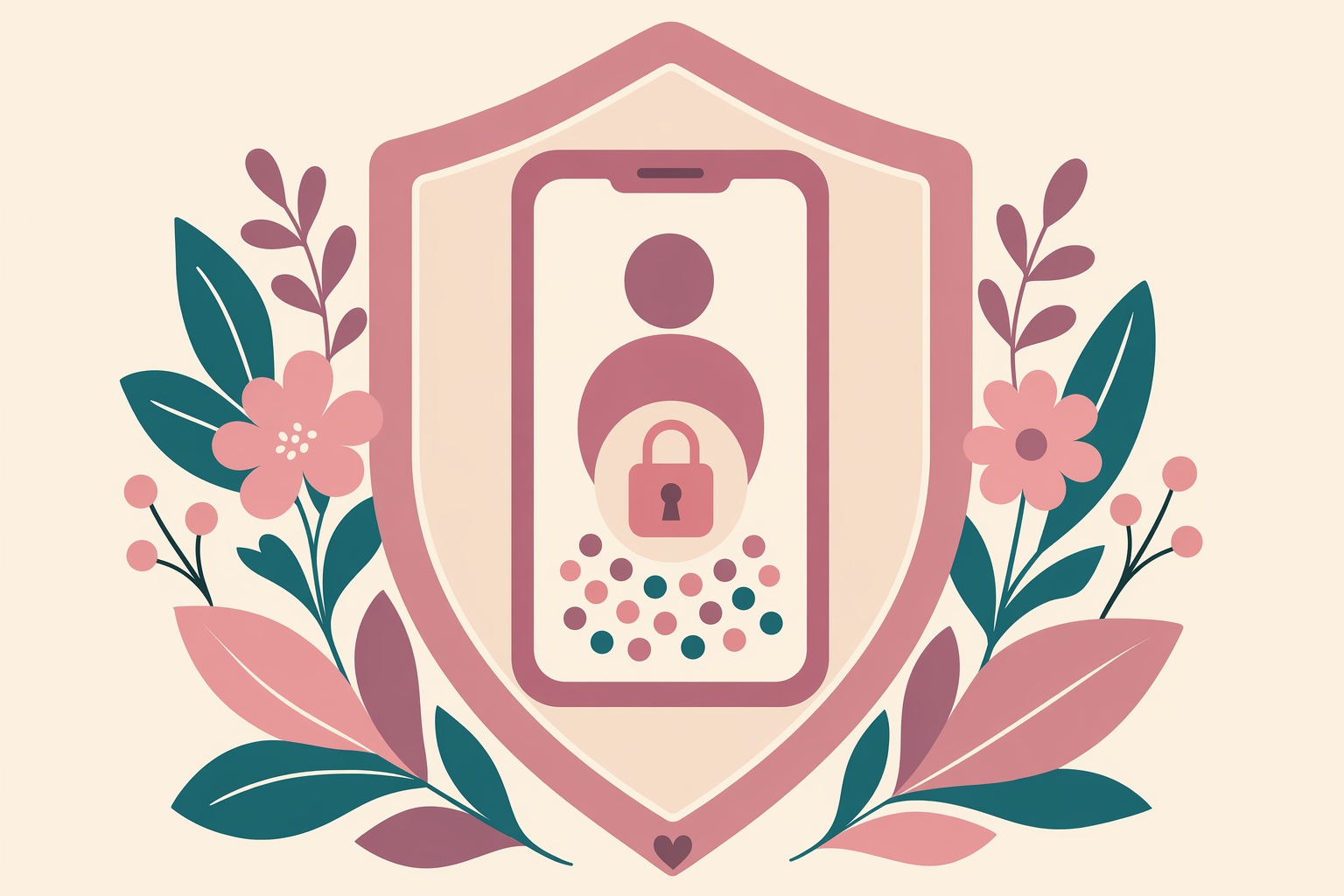
A private cycle tracking app can keep your health data on your phone and in your iCloud account rather than on the app maker's servers. Without an account, the app maker has no server-side identity tied to your personal information. If the company does not sell data, it does not monetize your cycle records.
The technical distinctions matter:
- No user accounts: no email, password, or server-side identity
- No company cloud database: cycle data, logs, and predictions are stored securely in your iCloud account, which is end-to-end encrypted by Apple. The app maker never has access
- No data selling: your health data is never monetized or shared with advertisers
- No third-party advertising: ad networks do not have access to your health context
- Anonymized usage analytics only: some apps (including Ovuly) collect anonymized statistics about which features are used, but this never includes health data, cycle information, or personal identifiers
What about Apple Health?
Apple Health is on-device by default. Its data lives in Apple's encrypted health database on your iPhone. It leaves the device only if you explicitly enable iCloud Health sync. With that setting enabled, the data is end-to-end encrypted and not accessible to Apple.
A privacy-focused app can offer Apple Health as an optional export, so you can take your data with you or sync it with other apps. That is different from sending data to the app company's own cloud backend.
What to look for in a private period tracker
When you assess a cycle tracking app's privacy claims, look for specific answers to these questions:
- Does it require account creation? If you need an email to use the app, a server is holding your identity.
- Who controls cloud sync? Apple iCloud sync is end-to-end encrypted by Apple. Sync to the app maker's own servers is a separate arrangement.
- Does the privacy policy say where data is stored, which analytics are used, and whether health data is excluded from analytics?
- Does the app carry advertising? Ad-supported apps share data with ad networks.
- Is Apple iCloud the only sync destination, with optional export to Apple Health for portability?
The trade-offs
Keeping data off the app maker's servers has practical limitations:
- There is no web dashboard because there is no server to host a web version.
- There are no social features because sharing data with a partner requires a server.
Your data is stored securely in your iCloud account using end-to-end encryption, so it syncs across your Apple devices and remains available if you switch phones. The app maker (like Ovuly) never has access to that data. You can export it to Apple Health if you decide to leave.
Keeping control of cycle data
Cycle tracking privacy is about deciding who can access deeply personal health data, especially in a legal and political environment where such data can be used against people.
Keeping the data on your device and out of an app maker's database gives you more direct control over it.
References
- Fowler GA. "Police can get your data — even from your period-tracking app." The Washington Post. 2023.
- Privacy International. "No Body's Business But Mine: How Menstruation Apps Are Sharing Your Data." 2019.
- Rocher L, Hendrickx JM, de Montjoye YA. Estimating the success of re-identifications in incomplete datasets using generative models. Nature Communications. 2019;10:3069.
- Apple Inc. "Apple Health — Privacy." Apple Developer Documentation. 2024.