
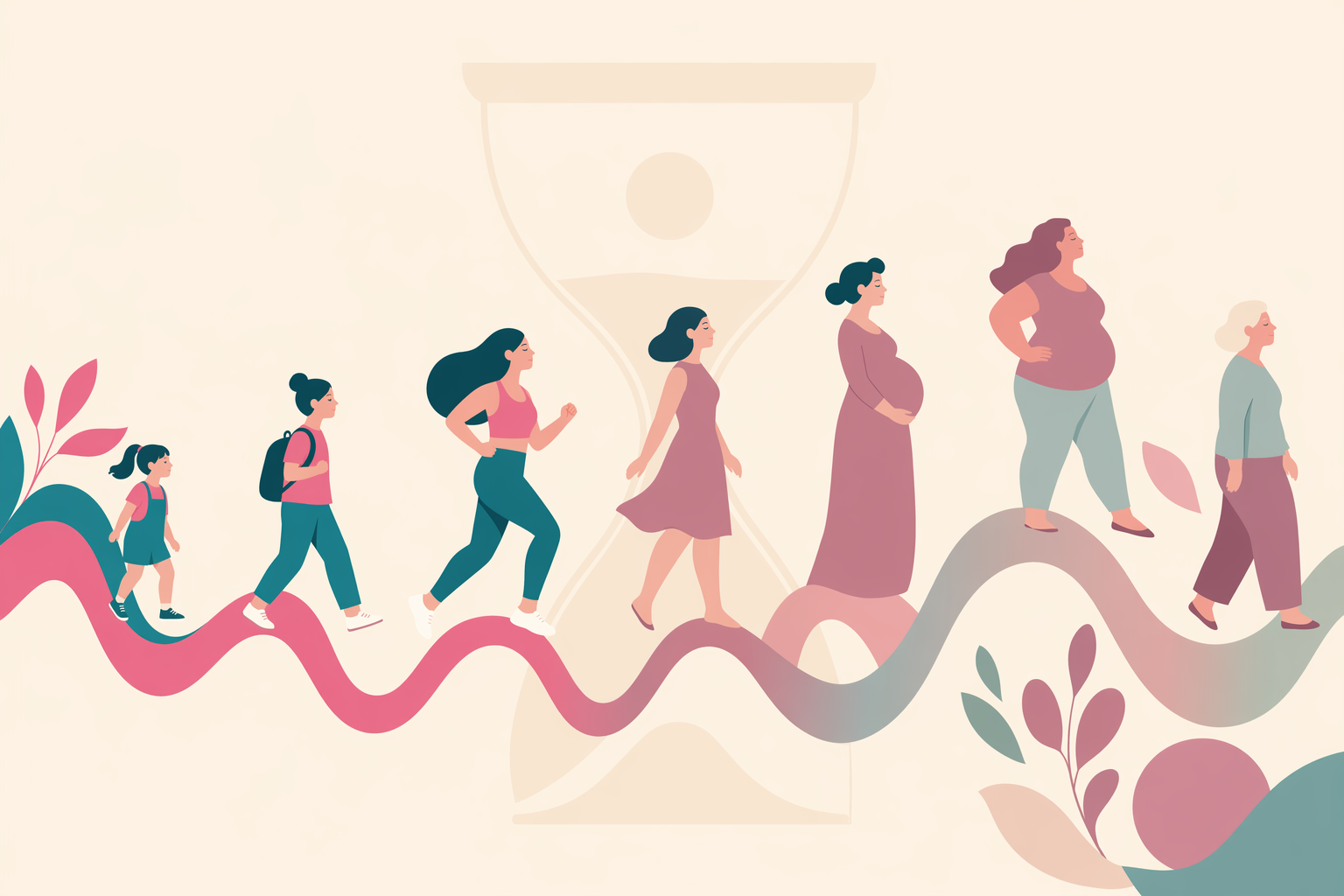
If your cycle differs from the one you had in your 20s, the change may be age-related. Menstrual cycles often shift between ages 30 and 50. Following the pattern can help separate common age-related changes from symptoms worth discussing with a doctor.
The big picture
Ovarian reserve, the pool of remaining eggs, is one factor governing the menstrual cycle. You are born with approximately 1–2 million oocytes. By puberty, around 300,000–400,000 remain. By age 37, the number drops to approximately 25,000, and the rate of decline accelerates from there.
A declining reserve affects fertility and can also change cycle patterns in measurable ways.
Your 30s: subtle shifts begin
Shorter cycles
One of the earliest changes is a gradual shortening of cycle length. A large study of over 600,000 cycles found that average cycle length decreases from about 29 days at age 25 to about 26 days by age 40.
This shortening almost always occurs in the follicular phase. As ovarian reserve declines, the remaining follicles are recruited faster. FSH levels begin to rise slightly, and the dominant follicle is selected sooner. The luteal phase typically remains stable at 12–14 days.
Hormonal changes
By the mid-to-late 30s, several hormone patterns may shift:
- FSH begins to rise as the pituitary works harder to stimulate the declining follicle pool.
- Estrogen may initially increase because faster follicle recruitment can produce higher early peaks.
- AMH (anti-Müllerian hormone) declines. This is the most reliable blood marker of remaining ovarian reserve.
- Progesterone production may become less robust, and some cycles may have shorter or weaker luteal phases.
What you might notice
- Cycles that are 1–3 days shorter than before
- Slightly heavier or lighter periods
- Earlier ovulation (day 11–12 instead of day 14)
- PMS symptoms that feel different or more pronounced
Your 40s: perimenopause
Perimenopause is the transition before menopause. It typically begins in the mid-40s (average age 47), though it can start as early as the late 30s. It lasts an average of 4–8 years before the final menstrual period.
What defines perimenopause
The hallmark of perimenopause is increased variability. Cycles become less predictable as ovulation becomes less reliable. For a broader look at cycle irregularity, see irregular periods causes:
- Some cycles are normal and ovulatory
- Some cycles are anovulatory (no ovulation), with no progesterone rise and potentially heavy, irregular bleeding
- Some cycles are much longer than usual (40+ days) because the follicular phase is extended
- Some cycles are shorter than expected
This variability reflects an inconsistent ovarian response to FSH, which makes follicle development less predictable.
Hormone fluctuations in perimenopause
Perimenopause does not involve a simple, steady decline in estrogen. Hormones fluctuate:
- FSH rises and fluctuates. It can be normal one month and elevated the next.
- Estrogen can swing widely. Some perimenopausal cycles produce higher peaks than in younger years before falling.
- Progesterone becomes inconsistent. It is present in ovulatory cycles and absent in anovulatory ones.
- Testosterone gradually declines, though more slowly than estrogen.
These estrogen swings explain many perimenopausal symptoms. Hot flashes, mood changes, breast tenderness, and sleep disruption often correlate more closely with estrogen volatility than with low estrogen.
Common perimenopausal symptoms
- Irregular cycle lengths are the defining feature.
- Heavier periods can occur because anovulatory cycles may lead to prolonged estrogen exposure and thicker endometrial buildup.
- Hot flashes and night sweats result from changes in hypothalamic thermoregulation.
- Sleep disruption can occur independently of night sweats.
- Mood changes are also common, and the risk of anxiety and depression increases during the transition.
- Vaginal dryness can develop as baseline estrogen declines.
What biometrics show as your cycle changes
Wearable data may help show how these transitions affect individual cycles.
Temperature patterns
- In your 30s, the biphasic pattern remains, but cycles may show earlier temperature rises that reflect earlier ovulation.
- In perimenopause, some months show a clear biphasic pattern (ovulatory), while others show flat or irregular temperature (anovulatory). This inconsistency can be informative. The BBT guide explains what the biphasic pattern means.
HRV
- HRV may vary more from cycle-to-cycle as hormonal patterns become less predictable. The full guide explains what HRV means across cycle phases.
- The overall trend of HRV declining with age may make cycle-phase detection less clear
Resting heart rate
- Continues to show cycle-linked oscillations in ovulatory cycles
- In anovulatory cycles, the pattern may flatten
What's normal vs. what needs attention
Common age-related changes include:
- Cycles shortening by 1–3 days in your 30s
- Increased variability in your 40s
- Occasional skipped periods in perimenopause
- Changes in flow volume
Discuss these changes with a doctor:
- Periods consistently closer together than 21 days
- Bleeding that lasts more than 7 days regularly
- Very heavy bleeding (soaking through protection hourly)
- Bleeding between periods
- Periods stopping before age 40 (premature ovarian insufficiency)
Following changes over time
Cycles commonly change with age. Predictable 28-day cycles may become shorter in your 30s, then more variable during perimenopause in your 40s. Tracking those changes provides a record that can help you distinguish a gradual age-related pattern from symptoms that deserve medical attention.
References
- Treloar AE, et al. Variation of the human menstrual cycle through reproductive life. International Journal of Fertility. 1967;12(1):77-126.
- Wallace WHB, Kelsey TW. Human ovarian reserve from conception to the menopause. PLoS One. 2010;5(1):e8772.
- Bull JR, et al. Real-world menstrual cycle characteristics of more than 600,000 menstrual cycles. NPJ Digital Medicine. 2019;2:83.
- Sherman BM, Korenman SG. Hormonal characteristics of the human menstrual cycle throughout reproductive life. Journal of Clinical Investigation. 1975;55(4):699-706.
- La Marca A, et al. Anti-Müllerian hormone (AMH) as a predictive marker in assisted reproductive technology. Human Reproduction Update. 2010;16(2):113-130.
- Harlow SD, et al. Executive summary of the Stages of Reproductive Aging Workshop + 10. Journal of Clinical Endocrinology & Metabolism. 2012;97(4):1159-1168.
- Prior JC. Perimenopause: the complex endocrinology of the menopausal transition. Endocrine Reviews. 1998;19(4):397-428.
- Santoro N, et al. Reproductive hormones and the menopause transition. Obstetrics and Gynecology Clinics of North America. 2011;38(3):455-466.
- Freeman EW, et al. Hormones and menopausal status as predictors of depression in women in transition to menopause. Archives of General Psychiatry. 2004;61(1):62-70.
- Munro MG, et al. FIGO classification system for causes of abnormal uterine bleeding. International Journal of Gynecology & Obstetrics. 2011;113(1):3-13.
- Cohen LS, et al. Risk for new onset of depression during the menopausal transition. Archives of General Psychiatry. 2006;63(4):385-390.
- Prior JC, et al. Ovulation prevalence in women with spontaneous normal-length menstrual cycles. PLoS One. 2015;10(7):e0135994.
- European Society for Human Reproduction and Embryology (ESHRE). Management of women with premature ovarian insufficiency. Guideline. 2016.